
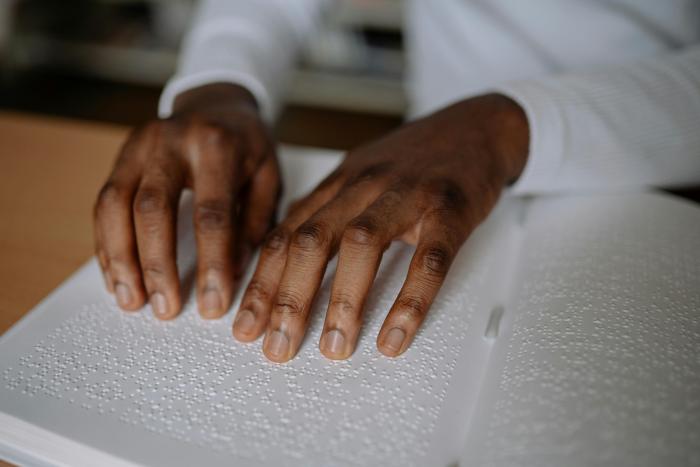
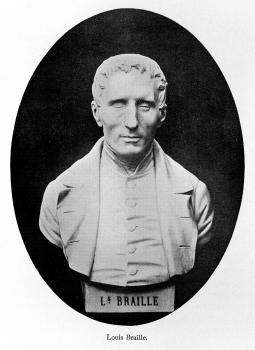
Reading helps us learn, grow, laugh and imagine, but what happens when your vision is gone, how do you read? In 1809 Louis Braille was born, he enjoyed learning and reading but at 5 years old an accident resulted in him losing his eye site. Louis’s world changed quickly. As he was plunged into darkness, he had to relearn much of what he already knew how to do. He had to relearn how to walk, how to eat, and how to use the restroom. The one thing Louis wanted to do the most was read.
In 1819 he was accepted to the London school for the blind. After lots of hard work and learning he was able to read the special books the school had for the blind. While reading this book which had typical letters written in raised wax, he found it very difficult to read and was upset at the huge text causing a book to be short or absurdly heavy. Later in school Louis and his classmates would learn “night writing” a French code that used raised dots to represent sounds. Louis and his classmates tried to learn night writing, but it was very confusing because each symbol represented a sound, not a letter.
Louis decided he would try to create a new system. Using tools similar to his father, a leather worker, created a code using 2 columns of three dots in different arrangements. He would later show this to his teacher and his classmates. Eventually in 1829 he would publish a book explaining his code and how to create it and it was adopted by France as the official system for the blind.
These articles are written by library staff using library resources such as books, eBooks, and databases. Information can vary from book to book and database to database. Tickle Your Brain is meant to be a jumping off point for starting conversations about new topics of learning. It is not to be used as an authoritative resource.
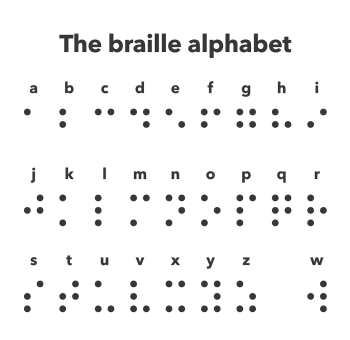
- Braille is not a language it is a tactile alphabet that can be written in almost any language.
- Braille comes in two forms contracted and uncontracted. Uncontracted means everything is written out completely, while contracted has shorthand to take up less space.
- There are toys and games available in braille, including Uno, Monopoly and Lego.
- Who was Louis Braille? By Margaret Frith
- A Picture Book of Louis Braille, by David A Adler
- Six Dots: A Story of Young Louis Braille, by Jen Bryant